15 October 2026
Why Multiplication Looks Different Now
This is the first in a series about content. What your child is being taught, why it's taught that way, and where it leads. I'm starting with multiplication, because it's the topic where parents most often look at a worksheet and quietly conclude that the school has lost its mind.
You were probably taught one method. Digits stacked up, carry the one, answer underneath. Your child is drawing a rectangle and chopping it into boxes. It looks like a detour. It isn't.
It starts as something you can count
In Stage 2, Years 3 and 4, multiplication is a picture before it's anything else. Six rows of five, drawn as squares:
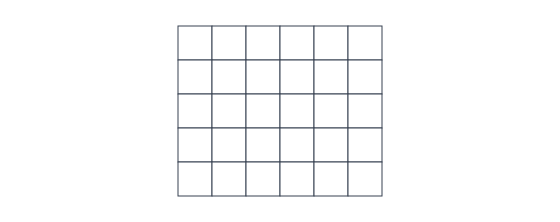
A child meeting this can answer "how many squares?" without multiplying at all. They can count every one. That isn't a failure of the task. It's the point. The array is there so that means something physical before it means a fact to be recalled.
The array does something else, quietly. It makes commutativity obvious. Turn the page ninety degrees and you have five rows of six. Same squares, same total. A child who has seen that doesn't need to learn and as two separate facts, which halves the number of times tables facts they have to hold.
Then the counting is taken away
Here's the step the whole progression turns on, and the one most parents never see.
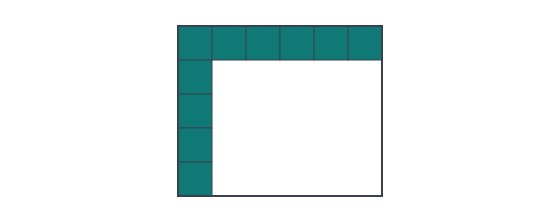
Same rectangle. Only the top row and the left-hand column are drawn, and the middle is empty. The child can still see six in a row, and five rows. What they can't do is count thirty squares, because thirty squares aren't there.
This is a deliberate removal of a strategy. It forces "how many in a row, and how many rows?" to become the operative question, because counting has been taken off the table. A child who has been coasting on counting gets found out here, and that's exactly when you want it to happen. Year 3, not Year 8.
Then the squares go too
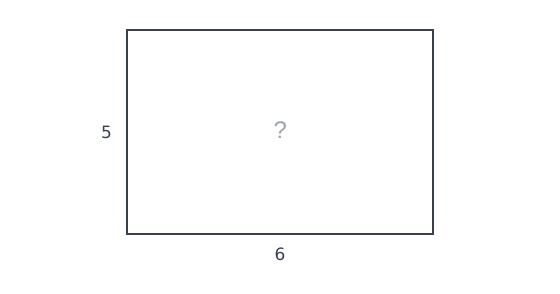
By the end of Stage 2 the squares have gone entirely. A rectangle, two labelled sides, and the understanding that the inside is the product. This is an area model, and it's the representation that will carry your child all the way to Year 10. The rest of this article is about what you can do with it once the squares are gone.
The algorithm you were taught
In Stage 3, Years 5 and 6, the formal written algorithm arrives. Here's the way you were almost certainly taught it:

I want to be clear that this is a great piece of mathematics, and anyone telling you it's obsolete is wrong. It's compact. It's fast. It's reliable. It scales to any number of digits without changing. Centuries of accountants and engineers got a very long way on it, and your child is still expected to be fluent in it by the end of primary school.
Its strength is that it compresses the thinking into a procedure. You don't have to understand place value at every step. You just have to keep the columns straight and remember what you carried.
Which is also precisely its weakness.
What the algorithm hides
Work through what you just did. You multiplied 4 by 3 and got 12. You wrote the 2 and carried the 1. But the 1 you carried wasn't one. It was one ten. Then you multiplied 4 by 2 and got 8, except the 2 wasn't two, it was two tens, so the 8 was eighty, and you added the carried ten to make ninety.
The algorithm is correct at every step and tells you none of that. A child can execute it perfectly while believing they're multiplying 4 by 2. That belief holds up fine until the day it doesn't.
So the area model is taught alongside it, not instead of it. Same calculation, nothing hidden:
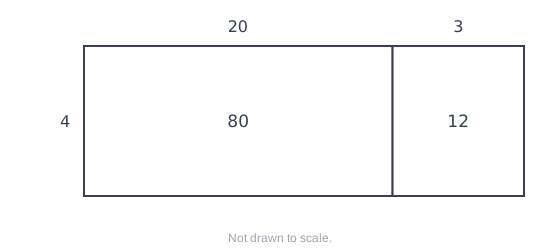
Twenty-three is split into 20 and 3, because that's what the digits mean. Four twenties is eighty. Four threes is twelve. Ninety-two. The carried 1 from the algorithm is sitting there in the open, as the ten inside that 12 that pushes the eighty up to ninety.
It's slower. That's not a defect for a child who is learning what the numbers mean. It's a defect only if you're in a hurry, and in Year 5 nobody is in a hurry.
Two digits by two digits
The real argument for area models shows up when both numbers have two digits:
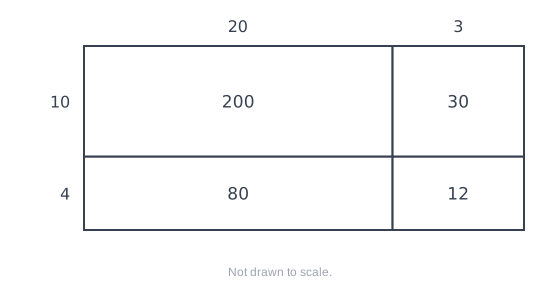
Four regions, because each part of one number meets each part of the other. Two hundred, thirty, eighty, twelve. Three hundred and twenty-two.
In the written algorithm this appears as two rows that get added, with a mysterious zero at the end of the second one. Every teacher has been asked why that zero is there, and "because you move it across" is not an answer. In the area model there's no zero to explain, because the row it belongs to is visibly the one multiplied by ten, not by one.
Three digits
Both methods extend. The algorithm barely changes:

Nor does the model. It just gains a region:
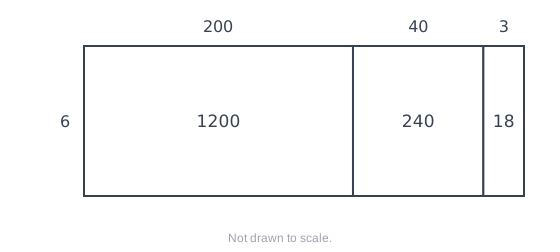
This is where the compactness of the algorithm starts to earn its keep, and where I'd expect a Stage 3 child to reach for it. But notice that the model still explains the algorithm rather than competing with it. The three regions are the three things the algorithm computes. It just doesn't write them down.
The split doesn't have to be into place value
Here's the part I most wish someone had shown me as a student, and the reason I think area models are undersold even by the people teaching them.
Nothing says a number has to be broken up by its digits. It has to be broken up into pieces that are easy to multiply. For a number like 98, the easy pieces aren't 90 and 8. They're 100 and negative 2:
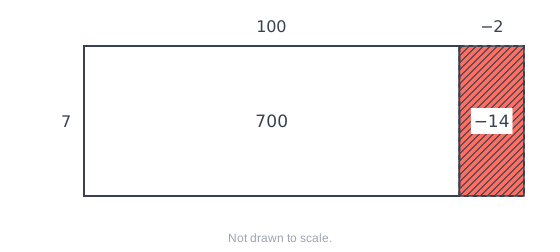
Same picture as before. One side is 7, and the other is written as , which is 98. Seven hundreds is seven hundred, a fact your child already has. Seven lots of negative two is negative fourteen, and that's the hatched region: it comes off rather than going on. Seven hundred take away fourteen is six hundred and eighty-six.
Try it in the written algorithm. It works, and it teaches you nothing. Done as a hundred minus a bit, most adults can do it in their head, and that's the point. A child who only has the algorithm has no mental method at all. They have a procedure that requires a pencil.
This is a reasonable thing to ask at home. When your child reaches for a pencil to do , the useful question isn't "what's the answer" but "is there an easier hundred hiding in there?"
Where all of this is going
Now the real reason none of it is a detour.
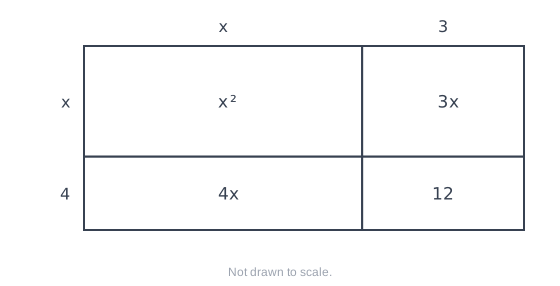
That's , which your child will meet in Stage 5, somewhere around Year 9 or 10. It's the same picture as . Identical. Four regions, each part of one side meeting each part of the other, add them up.
A student who understands the area model arrives at binomial expansion already knowing what it is. They've been doing it since Year 4. The only new thing is that one of the side lengths now has a letter in it. A student who only has the column algorithm arrives at the same lesson with nothing to connect it to, and has to memorise a rule, FOIL or whatever acronym is current, that works until the brackets have three terms in them and then stops.
That's the pathway. The array becomes the area model, the area model becomes the distributive law, and the distributive law is most of secondary algebra. The boxes on your child's worksheet in Year 4 are the same boxes they'll be drawing in Year 10.
So what should you do
Both. This isn't a case where the new way replaces the old one.
Your child needs the written algorithm, fluently, because it's fast and the curriculum expects it. They also need to be able to explain where the carried digit went, because that's the difference between knowing multiplication and knowing a procedure.
The test at home takes about thirty seconds. After they've worked something out, ask them to show you why it works, with a drawing. If they can produce a rectangle with the right pieces in it, they understand it. If they can only re-run the procedure more slowly, they have a method and not much else, and that's worth knowing in Year 5 while it's still cheap to fix.
If you want that kind of practice running in your house without having to plan it yourself, the free trial is the fastest way to see it work. If you'd rather read more of this sort of thing first, subscribe to the newsletter, this is the first of a series on content and the next one will get the same treatment.